
Overview
This document explains how folder settings and permissions function in U-M Dropbox.
Folder Types
You should familiarize yourself with the different types of folders in U-M Dropbox.
| Folder Image | Description |
|---|---|
 | Type: Private folder Owned by: You Icon: None |
 | Type: Shared folder Owned by: You or someone at U-M Icon: People |
| Type: External folder Owned by: Someone outside U-M Icon: People |
 | Type: Team Folder Owned by: MCommunity group Icon: Building |
 | Type: Team Folder (with read-only access) Owned by: MCommunity group Icon: Building with a lock |
Folder Sharing
Shared links
Shared links let you quickly share a file or folder with the right people without inviting them directly to the content. You can create separate links for edit and view access (one for each). The link settings for each look slightly different, but the experience is similar overall.
Caution: There are several caveats to using shared links that you should be aware of:
- If you remove someone's access and they still have the folder shared link, they could regain access (depending on the access level set). To prevent them from regaining access, someone with edit access to the folder should also delete the link. Learn how to remove a link to a folder.
- If someone you've shared a folder link with has joined that folder with their Dropbox account, the link permissions you set will no longer apply. Learn about joining shared folders.
- You can't create a shared link to a restricted subfolder in a Team Folder. "Restricted" means the subfolder has been shared with only select individuals, not the entire Team Folder membership, so only the individuals invited to the subfolder will have access.
- If the link recipient is a member of an external Dropbox Team account (i.e., not U-M), their ability to edit content depends on their Team's permissions.
- Shared links connect to the content itself, not a specific individual. This changed in 2024, when shared links were previously connected to individual users.
Link for editing
By default, when you click "Copy link" in the sharing dialog box, it creates a link with edit access and sets that access to "Only people invited."
Note: If you share with someone without a Dropbox account, they'll only be able to preview the folder (as if they had view-only access).
Access levels
There are three access levels you can assign to an edit access shared link (depending on your access to the folder):
Anyone with link
Anyone with access to the link can edit it. Use caution when choosing this option.
Team members
Anyone at the University of Michigan with a U-M Dropbox account can edit the link. This option will require users to sign in to their U-M Dropbox account.
Only people invited
Only the individuals shared on the folder can edit the link.
Caution: Do not choose this option if the user you intend to invite does not have a Dropbox account.
Link for viewing
To create a view access link, open the sharing settings for your folder, click the Link for viewing tab, and click Create link.
Access levels
There are four access levels you can assign to a view access shared link (depending on your access to the folder):
Anyone with link
Anyone with access to the link can view it. Use caution when choosing this option.
Team members
The link is viewable by anyone at the University of Michigan with a U-M Dropbox account. This option will require users to sign in to their U-M Dropbox account.
People with password
Anyone with the password can view the link. When someone opens the link, they'll need the password to view its contents.
Only people invited
Only the individuals shared on the folder can view the link.
Caution: Do not choose this option if the user you intend to invite does not have a Dropbox account.
Additional settings
There are three additional settings you can apply to shared links:
- Add a password
- Set an expiration date
Disable downloads (Only available on viewable links)
Note: Disabling downloads for a shared link prevents people from downloading the contents of a link through Dropbox. This doesn't prevent people from saving the content using other methods.
For more information on shared links and how to use them, refer to U-M's Share Files/Folders Using Shared Links and Dropbox's How to share a link to a Dropbox file or folder.
Subfolders
Shared folders and Team Folders have similar sharing structures for subfolders within the parent-level folder.
Shared folder subfolders
- You can create a shared link with edit or view access (one for each).
- You can add new collaborators with different permissions.
- Learn more about sharing subfolders in shared folders.
Team Folder subfolders
Subfolders in a Dropbox Team Folder can be shared with MCommunity groups, external (non-UM) users, and users who are not members of the Team Folder.
You will find two options when creating subfolders in a Team Folder. However, in some scenarios, you can only select the initial option during creation. Refer below for detailed information
Everyone with access to [Team Folder Name]
All Team Folder members (i.e., the members of the MCommunity group used at the parent level) will have access to the subfolder.
Only specific people
Only the individuals you invite to the subfolder will have access.
Important: This option is not available when creating subfolders under:
- The parent Team Folder (e.g., Team Folder A > Subfolder 1)
- A first-level Team Folder subfolder (e.g., Team Folder A > Subfolder 1 > Subfolder 2)
- UNLESS the first-level subfolder has already removed the inherited group
The option becomes available again at the third-level subfolder.
However, there is a workaround for mirroring the Only specific people option after the first- or second-level subfolder is created:
- Create the first- or second-level subfolder.
- Click Share folder in the top right.
- Enter the email address of the person or group you want to share with in the field provided, then select them from the drop-down results.
- Select Can edit or Can view if available.
- Click Share.
- Click Everyone with access to [Team Folder Name] under "Who has access."
- Click Remove inherited members and click Remove to confirm.
- Dropbox may fail to remove them the first time. If that happens, repeat steps 6 and 7 until they are removed.
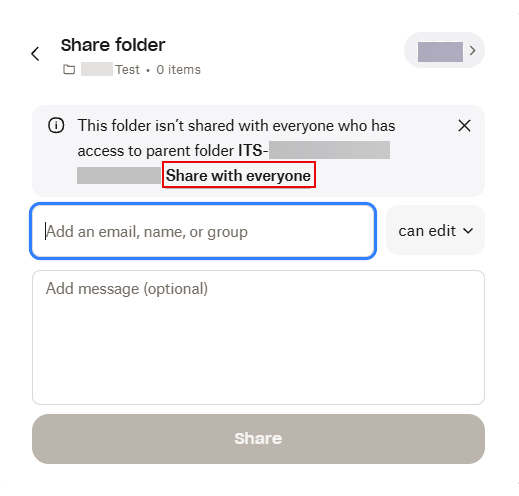
- If you complete this step first before sharing with your intended collaborators, Dropbox will automatically add back all Team Folder members.
To add them back after removal, click the sharing field, then click Share with everyone in the gray box.
Team Folders
An MCommunity group manages all Team Folder access and membership at the parent level. This means that individuals cannot be the sole parent-level managers.
For more information on Dropbox Team Folders, refer to Team Folders in U-M Dropbox.
Permissions
As an owner, you can grant a collaborator two levels of access in U-M Dropbox: Can view (viewer) and Can edit (editor). The chart below includes what each role can and can't do with shared folders (and files).
Note: You cannot assign the Can edit permission at the file level in U-M Dropbox unless the files are web-based, like Microsoft Word documents. All files are Can view unless Can edit access is given at the folder level in which the file resides.
| Owner | Can edit (Editor) | Can view (Viewer) | |
|---|---|---|---|
| View folder contents |  | | |
| View folder members and their roles |
| | |
| Comment on files in the folder |
| | |
| Download folder contents (if not disabled) | | | |
| Email members | | | |
| Leave the folder |
| | |
| Edit folder contents | | |  |
| Invite and remove members | | | |
| Change the roles of other members | | | |
| Cancel invites and re-invite members | | | |
| Make another member the owner | | | |
| Determine who can be invited to the folder | | | |
| Determine who can manage membership of the folder | | | |
| Move shared folders into Team Folders | | | |
| Unshare the folder | | | |